AI Can Make a Promise. Who Delivers the Order?
 Open full-size visual ↗
The commerce engine connecting AI intent to business execution
27 October 2026 / Genesis Block
As intelligence becomes easier to access, the next commercial challenge is making the promise operational: the right customer, the right seller, the right price, a confirmed payment and an accountable delivery. Genesis Block provides documented order and payment primitives on which that execution model can be built.
The moment a conversation becomes a commitment
A fluent answer creates an expectation. A commercial system must establish what the business has actually agreed to do.
The customer asks an AI assistant to arrange a consultation, add a hotel service or purchase supplies. The response arrives instantly: here is an option, here is the price, here is the next step. Then the business must deliver. A customer identity has to match a seller, a service has to match a price, and someone has to know whether the transaction is ready to proceed.
Our opening Macrohard article examined the shift toward AI doing work on a user's behalf. This episode follows the commercial consequence. When AI becomes the interface, the order becomes a crucial bridge between the conversation and the operation.
A chat transcript can explain what the customer wanted. An order must establish what is being sold, by which organization, in which currency and under which rules. Payment and fulfillment then need their own evidence. Treating all of this as one successful tool call hides the very exceptions a business has to manage.
Genesis Block, founded by Ekaterina Malikova, approaches this problem through reusable commercial infrastructure. Its documented order engine already connects organizations, sales locations, customers, products, services and payment records. The opportunity is to make these objects available to carefully authorized AI workflows. [1]
The customer remembers the promise. The business needs a record it can execute.
The anatomy of an executable order
The useful abstraction is a structured commercial object that retains context as the transaction moves forward.
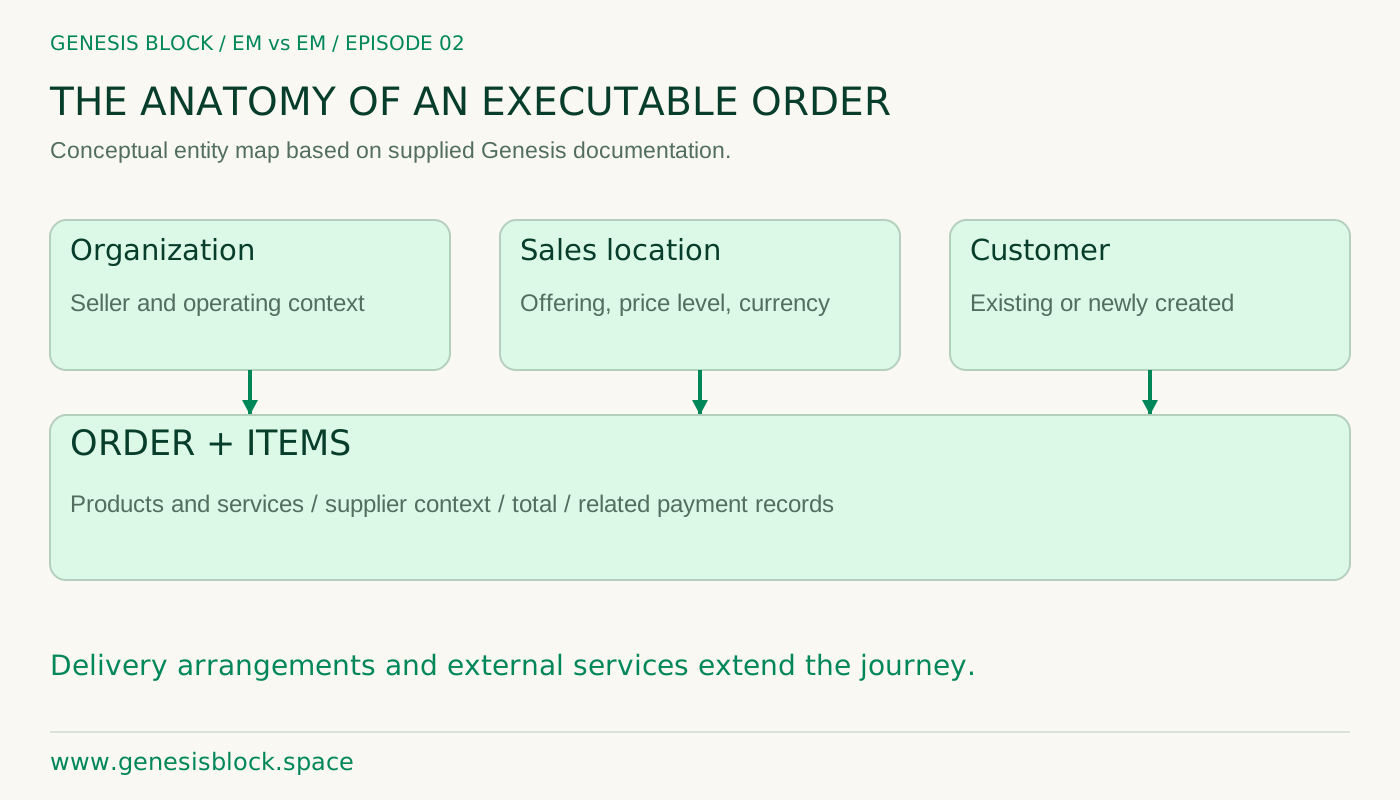
Genesis documentation describes an order-creation process in which an operator selects an organization, a place of sale, an existing or new customer, and the required goods or services. The place of sale determines the available offering, price level and order currency. An order can be saved for further work or formally placed. [1]
These details matter for AI. A request to sell the same service in two locations cannot safely assume identical prices or currencies. A natural-language intention should first resolve to the permitted organization, offering and price context.
The documented interface also supports viewing order items by supplier and, at the initial stage, adding or removing items. This gives a marketplace or mixed-service product a useful starting point. Availability, reservations, tax calculations and other vertical requirements must still be established for the selected implementation. They are not inferred from the existence of an order screen.
One order, several independent truths
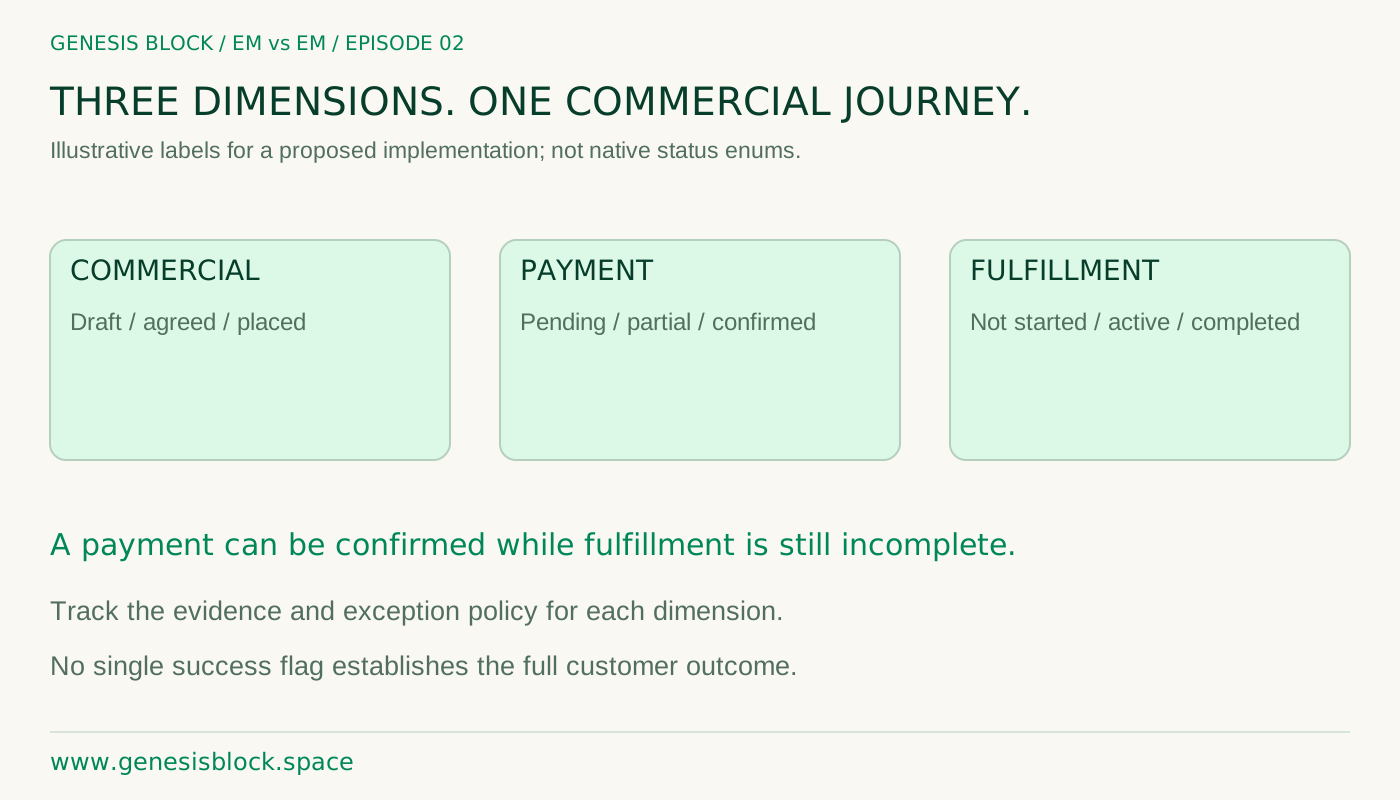
Placed, paid and delivered answer different questions. A reliable operation preserves the distinctions.
An order may be commercially accepted while payment is pending. Payment may be confirmed while fulfillment is still in progress. Delivery can fail after collection, creating a new obligation to the customer. None of these combinations can be understood from a single green success indicator.
Genesis records payment results including success, failure and timeout, and provides separate delivery administration. The order documentation describes selecting whether payment is due before delivery or on receipt. It also describes courier assignment, address or delivery-service changes, and delivery confirmation or cancellation. [1]
An AI layer should read these records before reporting completion. A timeout is an unresolved observation; it does not establish that a payment failed or that a retry is safe. A practical deployment needs explicit policies for delayed provider responses, contradictory events and manual resolution.
Partial payment is a real business requirement
Deposits, selected items and multiple payments expose the limits of simplistic transaction flows.
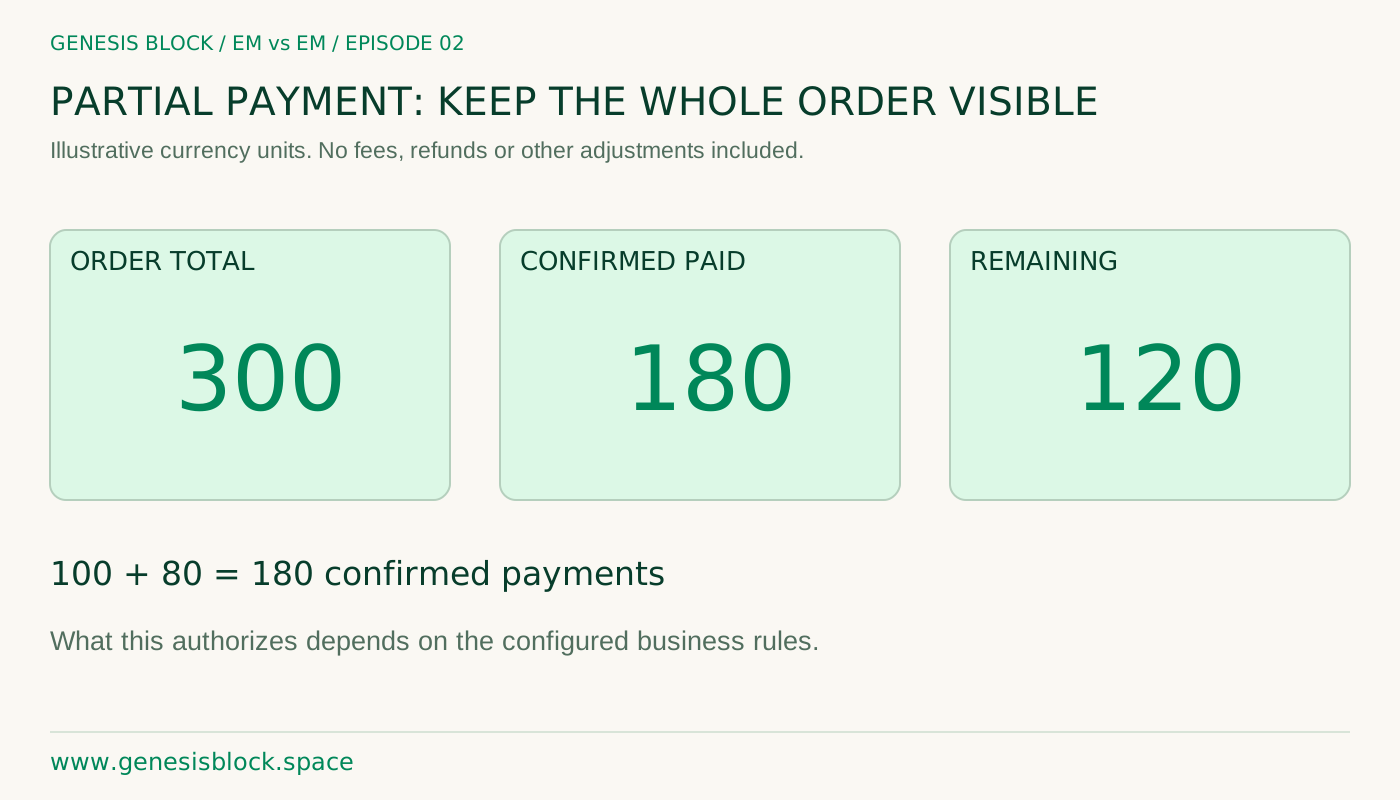
The documented Genesis flow supports full payment, partial payment and partial payment with a selection of the order items being paid. One or more payments can be associated with a placed order. Payment links and QR codes are available where the selected payment method supports them. [1]
Imagine a 300-unit service order. One confirmed payment contributes 100 units and another contributes 80. Before refunds, fees or other adjustments, 120 remains. The arithmetic is simple; the operational question is whether that payment state authorizes the next action.
A deposit may authorize preparation but not final delivery. Payment for selected items may authorize those items while leaving the rest outstanding. These are deployment-specific business policies that must be implemented explicitly. The documentation establishes payment flexibility; it does not establish every possible automated release rule.
For a buyer, the value is flexibility within a coherent commercial record. For an AI agent, the requirement is precision: say what has been paid, what remains due and what the business is authorized to do next.
Follow one customer all the way through
A useful demonstration ends with the business outcome, including the exceptions the customer can actually encounter.
Consider an illustrative hotel concierge. A guest requests an airport transfer and a consultation. The application identifies the hotel organization and guest, resolves the appropriate offerings and prices, and prepares an order. Transfer availability and the consultation slot are checked through the relevant external systems; those checks require suitable integrations.
The guest agrees to the offer and follows a payment link. The payment provider performs collection and the application records the observed result. If only the transfer item is paid, the system should report that fact rather than describing the whole package as paid.
Fulfillment then proceeds under the configured policies. The transport provider and professional remain responsible for their services. Documents can draw on the recorded commercial data through the documented Genesis template layer. Loyalty or referral treatment depends on the agreed configuration. [1][2][3]
If the consultation becomes unavailable, the application needs an exception path: revised offer, customer consent, cancellation or a refund handled through the appropriate provider. This example is a proposed deployment flow, not a claim that Genesis already operates this particular concierge product.
 Open full-size visual ↗
Give the agent a bounded commercial job
Useful autonomy begins with a clear action, a permitted scope and a way to establish what happened.
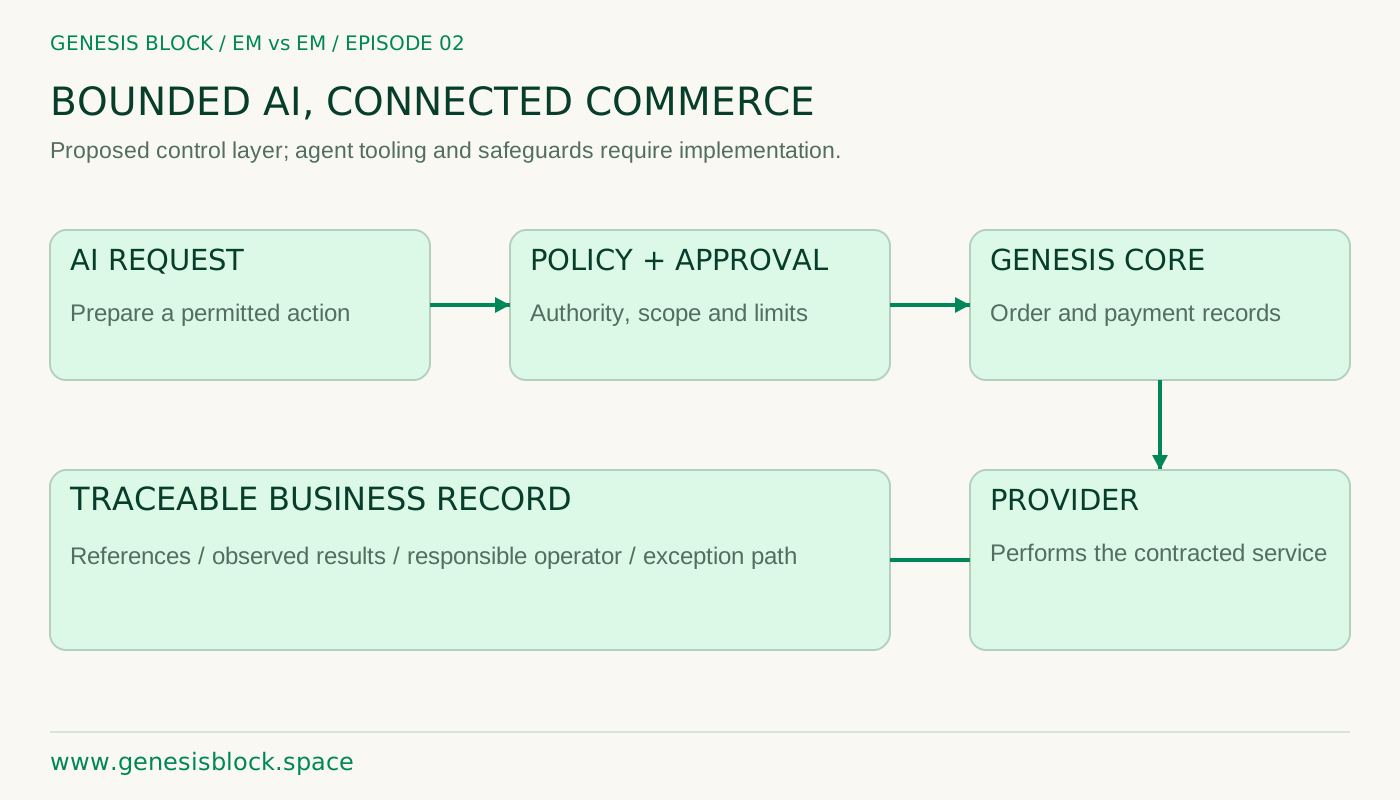
A practical agent assignment is narrower than 'run the business.' It might be: prepare an order for this customer, using these services and this price list, then ask an authorized person to approve it. A later version might permit placement within a defined scope and spending limit.
The control layer should establish who the agent acts for, which organization it may access, which operations it may request and which changes require human approval. It should retain the references needed to trace a proposed action to the order and provider interaction that followed.
This is the proposed AI extension around Genesis, not a claim that the order engine alone provides a complete agent-permission system. The documented objects and external-service adapters provide a foundation. Tool interfaces, authorization checks, approval flows, cost controls and evidence handling must be built and tested for the deployment. [1][3]
The EM vs EM question becomes operational: what can the agent commit to, and which component has authority to make that commitment real?
Design the recovery before the happy path
Retries, duplicate events and late confirmations are ordinary operational conditions.
Suppose a payment request times out and the agent repeats it. Did the first attempt fail, or did the response disappear after the provider accepted it? The integration has to resolve that ambiguity without accidentally creating a second operation.
Stripe's API documentation illustrates a general engineering pattern: idempotency keys can allow retries to refer to the same operation rather than create another one. Its webhook guidance also addresses duplicate delivery and event-ordering limitations. These are provider-specific documented behaviors, cited here as integration design references, not evidence of a Genesis-Stripe partnership or a verified connector. [4][5]
For Genesis deployments, establish the transaction references, reconciliation rules and provider behavior explicitly. Authenticate incoming events, process duplicates safely and read the latest authoritative state when necessary. Verify the actual implementation rather than assuming these protections exist because a platform has payment records.
A useful exception queue should identify the order, the uncertain action, the last known provider result, the responsible operator and the permitted next step. Designing this proposed workflow early makes the demonstration more credible: show how the business recovers when a system is slow, an item is unavailable or a customer changes their mind.
A retry should recover the action, not multiply the customer's obligation.
Define the outcome before pricing it
Payment received and value delivered are related commercial events, with different acceptance criteria.
Outcome pricing sounds simple until the parties define 'done.' For a consultation, completion might require attendance or a service record. For a physical order, dispatch and customer receipt are different events. For a digital deliverable, an upload may precede acceptance and revisions.
An order engine helps associate these events with the customer and commercial terms. It does not automatically determine quality, legal performance or customer acceptance. A proposed outcome layer needs explicit criteria, evidence sources, review windows and exception handling.
The billing arrangement should follow those rules. An implementation could use a setup fee, recurring service, transaction fee or a defined outcome fee. It should also explain refunds, disputes, failed attempts and human intervention. No single pricing model follows inevitably from adding AI.
This is where Genesis can contribute to the outcome-economy thesis: a connected order, payment and document model can serve as a commercial foundation. Acceptance logic and automated outcome billing remain deployment work that must be specified, implemented and validated.
The order records the promise. Acceptance establishes whether the promised result was delivered.
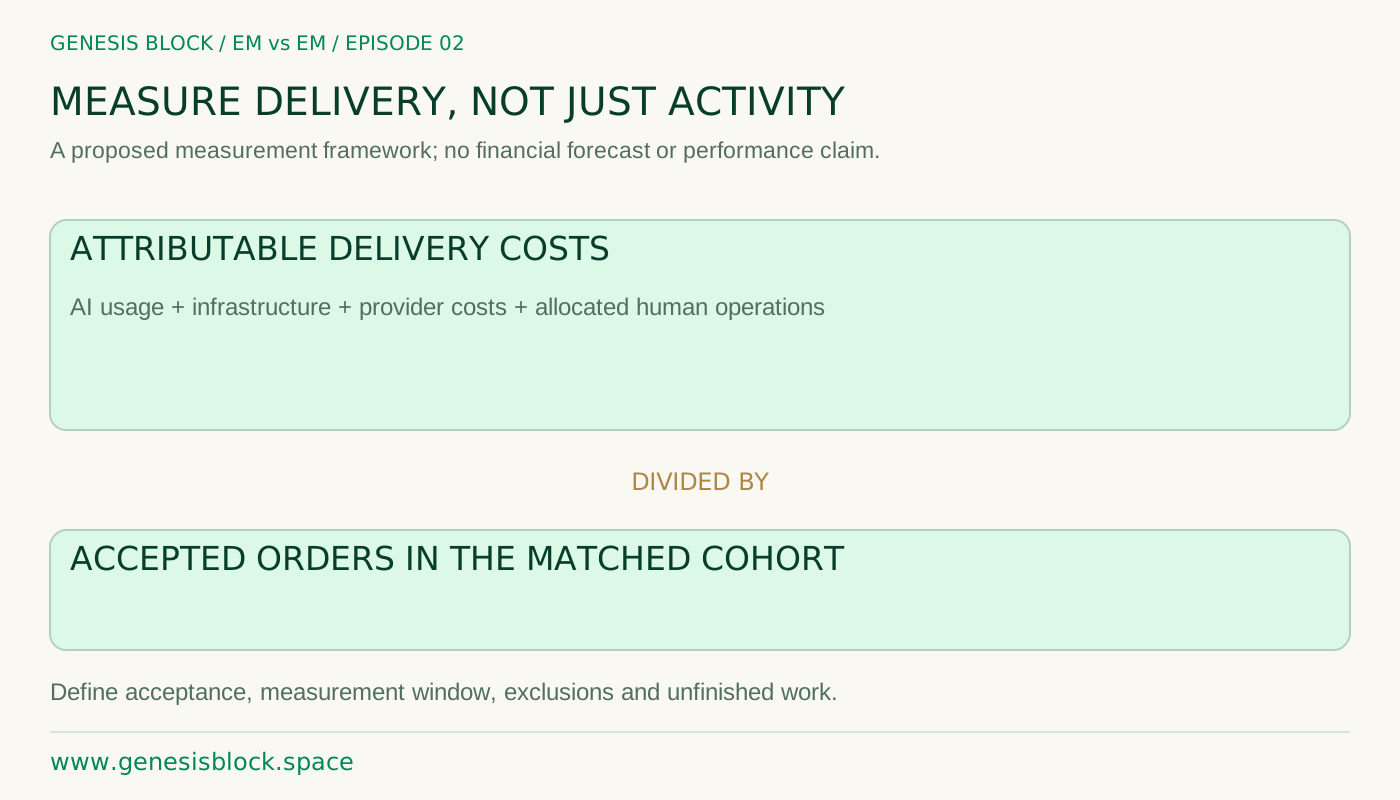
Measure cost per accepted order
The strongest evidence is a reproducible operational result, with its full delivery cost visible.
Counting agent calls measures activity. A buyer needs to know whether the process produces reliable orders. An investor needs to know what it costs to operate and reproduce the process.
Track the journey from proposed order to customer agreement, confirmed payment and the relevant fulfillment or acceptance event. Measure exceptions, manual interventions, duplicate operations, time to resolution and cancellation. Use explicit denominators so an improvement cannot be manufactured by excluding difficult cases.
Calculate cost per accepted order using the chosen cohort's AI usage, infrastructure, provider costs and allocated human operating costs. Match costs and accepted orders over an appropriate measurement window, account for unfinished work, and disclose what is excluded. An accepted order is not automatically profitable; contribution also depends on the revenue and costs the business actually bears.
The architecture earns its commercial argument when these measurements improve and the next deployment can reuse meaningful parts of the workflow. This article makes no claim of measured Genesis conversion gains, launch-time savings or returns.
Build one journey that deserves to scale
The next step is a narrow operational demonstration that a customer can examine and trust.
Start with one organization, one customer segment and one clearly defined offer. Establish the price and currency context. Configure the order journey, payment provider, delivery or service process, and document template. Decide who may approve each consequential action.
Demonstrate a complete successful transaction, a partial payment, a timeout and a fulfillment exception. Inspect the resulting records. Then repeat the flow with a second organization or offering and measure what can actually be reused.
The foundation already described in Genesis documentation is concrete: orders linked to organizations, locations, customers and items; multiple payment modes; observed payment results; and delivery administration. [1] The AI layer should make those objects easier to operate while respecting their commercial boundaries.
Intelligence can help discover the offer and prepare the work. A customer relationship lasts when the business knows what it promised, what it collected, what it delivered and what it still owes.
That is the direction of Genesis Block: connecting AI intent to accountable commercial execution. Build your business on Genesis. www.genesisblock.space
One core. Real orders. Accountable execution.
Sources and evidence
- Genesis / PayHub - Orders - Supplied technical documentation. Directly reviewed 27 October 2026. Organization/location selection, customers, items, full and partial payments, selected items, links/QR and delivery administration.
- Genesis / PayHub - Documents - Supplied documentation reviewed during series preparation. Template-based document generation; confirm templates and applicable requirements for each deployment.
- Genesis / PayHub - External Services - Supplied documentation reviewed during series preparation. External adapters and configuration inheritance. Does not establish every named provider is integrated.
- Stripe API - Idempotent Requests - Primary external engineering reference, reviewed 27 October 2026. Provider behavior varies by API version; no Genesis integration or affiliation is asserted.
- Stripe - Receive Events in Your Webhook Endpoint - Primary external reference, reviewed 27 October 2026. Asynchronous provider events, signature verification, duplicate handling and event ordering.
Genesis claims are bounded by supplied documentation. Illustrative flows and state labels are design proposals. AI permissions, automated release rules, outcome acceptance and recovery tooling require implementation. No deployment results, returns or affiliations are asserted. Founder attribution supplied by Vladislav Sapozhnikov. EM vs EM is an editorial thought experiment; it does not imply an actual debate or endorsement by Elon Musk.
www.genesisblock.space