
How do you like THAT, Elon Musk?
Elon Musk's Macrohard ambition points toward software that performs the work of companies. The commercial opportunity reaches beyond smarter agents: every AI-powered business still needs customers, orders, payments, partners and a reliable record of what was delivered.
Macrohard and delegated work
A commercial core for AI businesses
Accepted outcomes and unit economics
The company becomes the interface
Elon Musk's Macrohard idea pushes AI beyond helping employees use software. Its stated ambition is to reproduce functions of a software company itself. That is a much larger proposition than an assistant that writes an email or generates a page of code.
In his original announcement, Musk invited people to build a purely AI software company called Macrohard, a deliberate play on Microsoft. A later public description identified Macrohard, also called Digital Optimus, as a joint xAI-Tesla project. Grok would provide high-level direction while the action system interacted with the computer environment. These are descriptions of an announced ambition, rather than evidence that every promised capability is commercially deployed. 1,2
The strategic shift is from operating an application to delegating a business process.
The strategic reading is that the application interface could stop being the main boundary of the product. A person asks for a completed process; the system chooses tools, moves between them and returns a deliverable. The user cares less about which screens were visited than whether the job was finished correctly.
Consider the difference between buying software to manage supplier proposals and asking a system to collect proposals, compare them against approved criteria, prepare a purchase order and route it for authorization. The latter crosses research, documents, procurement and finance. Its value sits in the coordinated process.
This creates pressure on two established arrangements: selling access to individual applications and organizing work around people who manually connect those applications. The implication is an opportunity to redesign both. It is an analytical inference from the direction of the technology, not a confirmed Macrohard pricing policy or a prediction that subscriptions will disappear.
The question for a founder becomes practical. As intelligence becomes easier to purchase, which parts of a business should be generated for each task, and which parts should remain dependable, reusable infrastructure? Customer relationships, commercial commitments and payment records belong at the center of that discussion.
Customers buy completed work
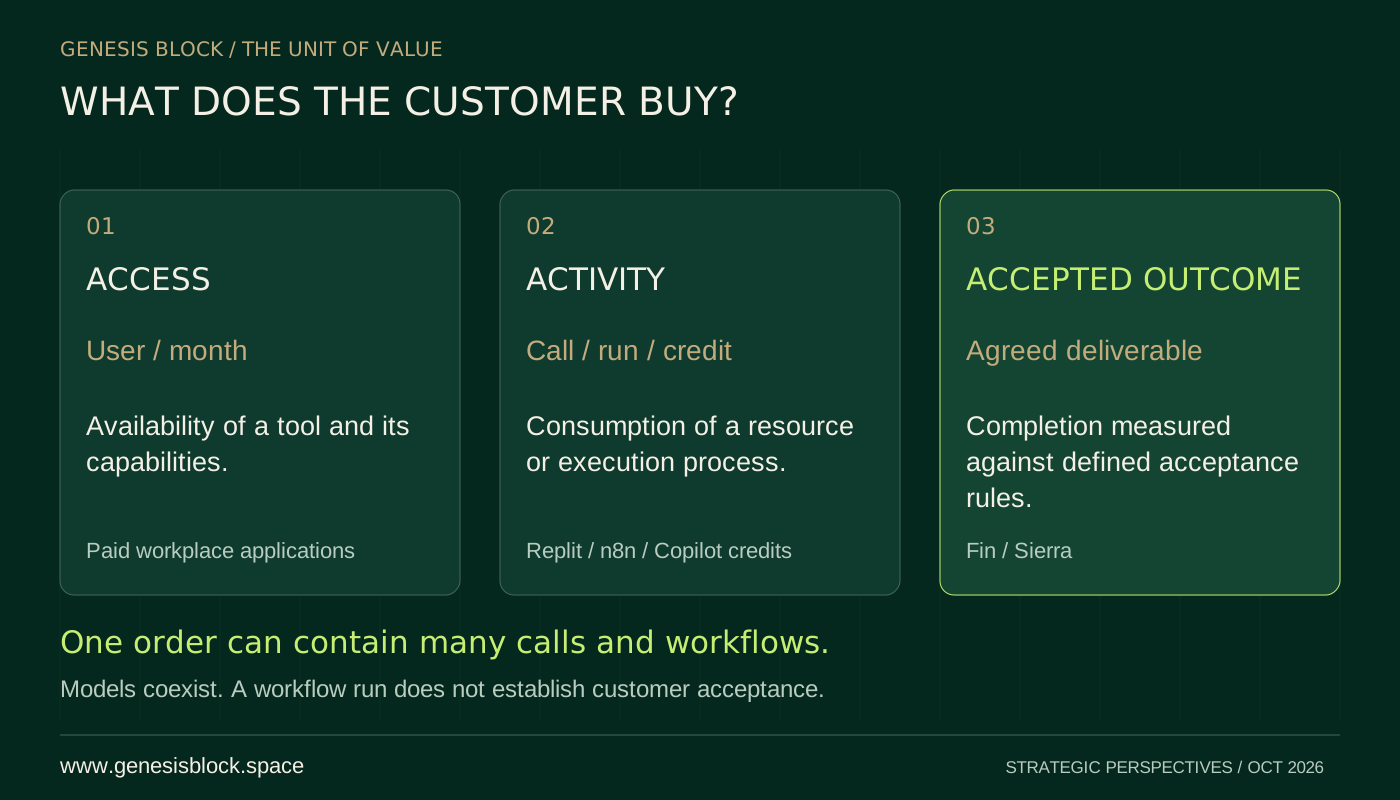
The market already contains several answers. Claude Cowork delegates work across files and tools through a paid product. Replit describes Agent pricing in terms of the time and computation required to fulfill a request. n8n meters workflow executions. Each expands what software can do, while charging for a different unit. 3,4,5
Outcome pricing goes further. Intercom's Fin documentation, for example, lists $0.99 for a support resolution and specifies how that outcome is counted, including confirmed and assumed resolutions and later reversals. Sierra ties its commercial model to agreed outcomes, while emphasizing that autonomy and clear attribution are necessary for that model to work. 6,7
Large incumbents are adapting too. Salesforce offers action, conversation and user-based options for Agentforce. Microsoft Copilot Studio offers credit-based consumption, including pay-as-you-go. The direction is a coexistence of business models, with the unit of value becoming more explicit. 8,9
For an operator, the useful distinction is simple: a model invocation measures consumption; a workflow run measures activity; an accepted deliverable measures contractual completion. One customer order may contain many of the first two. Selling the third requires a system that can connect all three.
Intelligence still needs a business
An AI service becomes a business when someone can reliably buy it, receive it and buy it again. That requires more than a model and a prompt. The operator needs a customer identity, a service definition, a price, an order, an execution owner, a payment status and a record of acceptance.
The same operation also needs to distinguish promises from facts. A proposed refund differs from an executed refund. A customer saying they have paid differs from a provider confirmation. A generated document differs from an approved deliverable. These distinctions determine revenue, customer trust and who carries responsibility.
A reusable commercial core can preserve those distinctions across changing tools. It can hold the business record while specialist agents, external APIs and people perform the work. An agent may choose an action; configured rules determine whether the action is permitted and which event changes the order.
That creates an infrastructure opportunity alongside the model race. Founders can purchase intelligence from multiple providers while sharing a common foundation for customers, commerce and execution. Distribution partners can launch specialized services without repeatedly assembling the same commercial plumbing.
This is the lens through which Genesis Block becomes relevant. Its opportunity starts with the transactional structure of the business, then extends that structure so AI can operate within it. The strategic continuity matters: the intelligence layer evolves quickly, while orders, counterparties, money and evidence need to remain connected.

Genesis starts with the commercial core
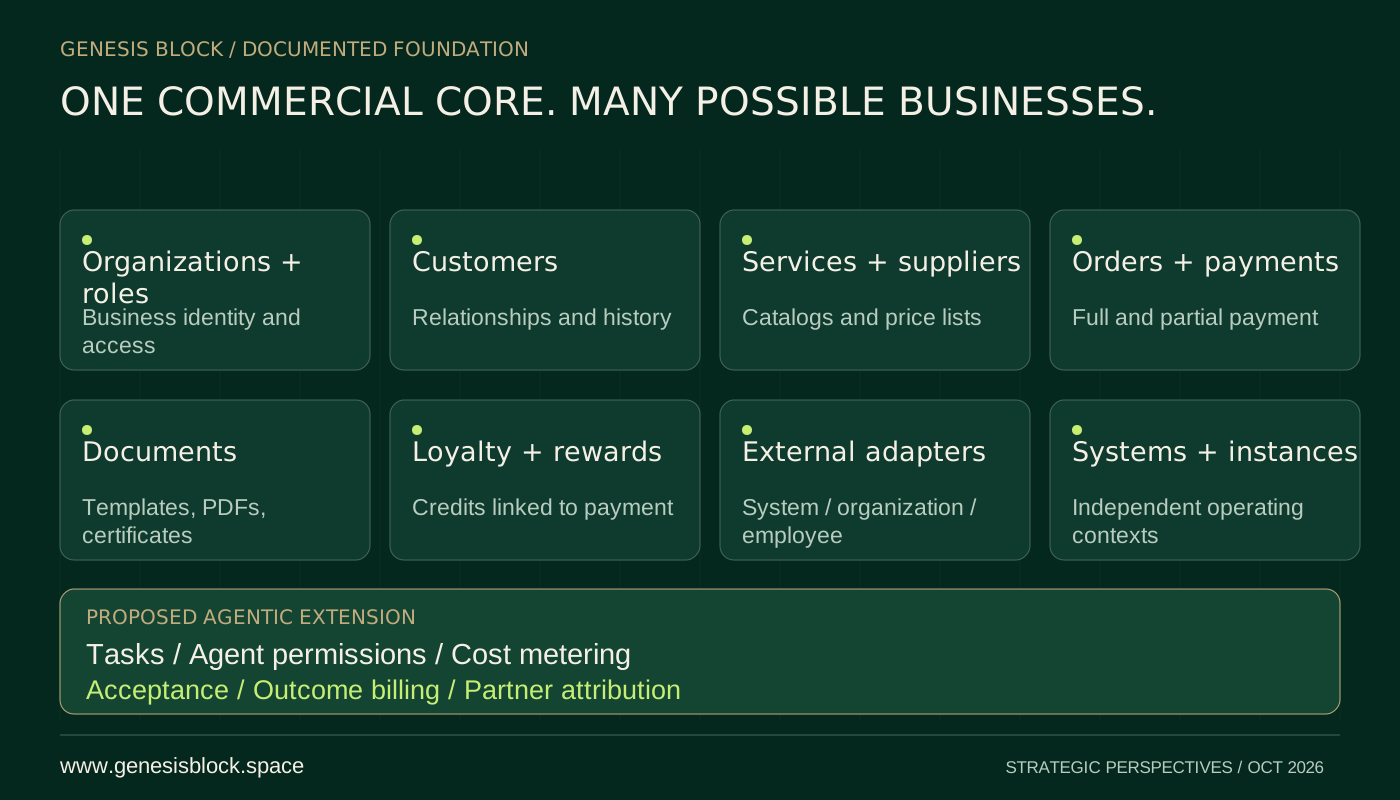
The supplied Genesis/PayHub documentation describes an order management system with APIs for products and services, users, customers, organizations and sales locations. It includes external payment processing, loyalty credited after payment, document generation and management of multiple instances. 13
The detailed records add commercially useful structure: price lists and currencies; supplier-seller relationships; full and partial payments; contracts, invoices and certificates; organizational hierarchies; and independent systems with their own organizations and customers. External adapters inherit configuration at system, organization and employee levels. 14
These are reusable building blocks for an AI-powered service business. A capability can be represented as a service, a provider as a supplier and a customer commitment as an order. Different front ends can address different industries while sharing the underlying commercial model.
Genesis's historical processing documentation also describes provider switching, limits, agent and sub-agent structures and automated remuneration. This is relevant architectural heritage. Bringing those capabilities into a new agentic product requires an explicit integration and verification scope; commercial payment agents are distinct from AI agents. 15
The proposed evolution is therefore concrete: extend a documented business core with task execution, agent-specific permissions, acceptance records, usage costs and controlled billing.
The order becomes the unit of execution
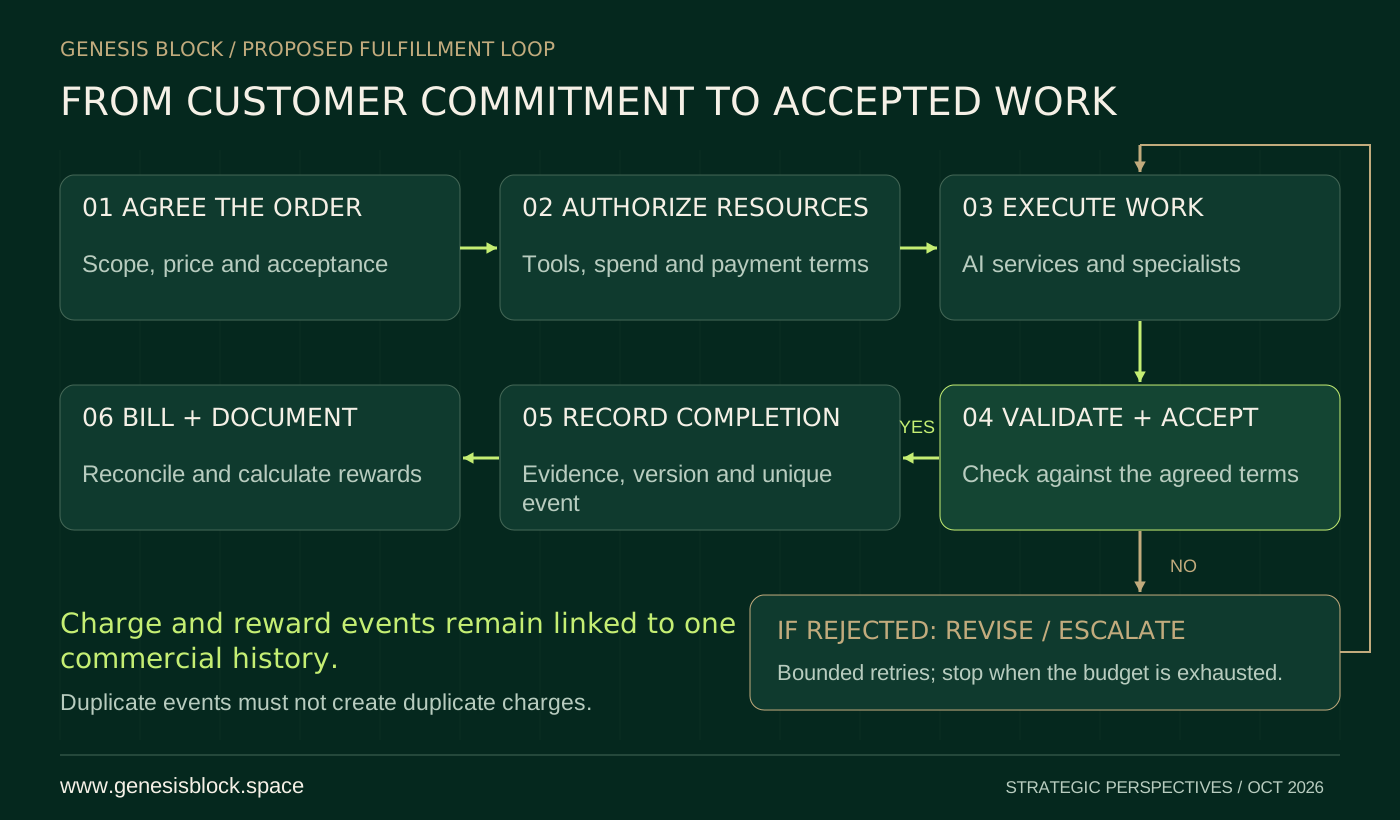
Suppose a property agency buys a package of listing materials. The commercial promise specifies the number of listings, source information, formats, deadline and included revisions. Internally, research, writing, image preparation and review become separate tasks. The customer still has one coherent order.
A proposed Genesis Outcome Engine would connect those tasks to the order. Each job would carry an owner, permitted tools, a spending ceiling, a result format and a bounded retry policy. Outputs would be versioned and checked before the order could reach its accepted state.
Acceptance must match the product. Structured data can be checked against a schema and source evidence. Brand-sensitive content may require an editor and customer approval. Financial drafts may require a qualified reviewer. A second AI model can assist evaluation, but its score alone should not establish every commercial result.
The completed record then supports the next actions: calculate the remaining balance, generate the appropriate documents and determine an earned partner commission. Actual money movement is executed through the connected provider under the agreed authority.
Duplicate events, corrections and refunds must preserve the same commercial history. A repeated callback should not create another charge or commission. A failed attempt should remain visible in the cost of delivery. These controls form part of the proposed implementation, rather than assumptions about existing readiness.
Open by design. Accountable in operation.
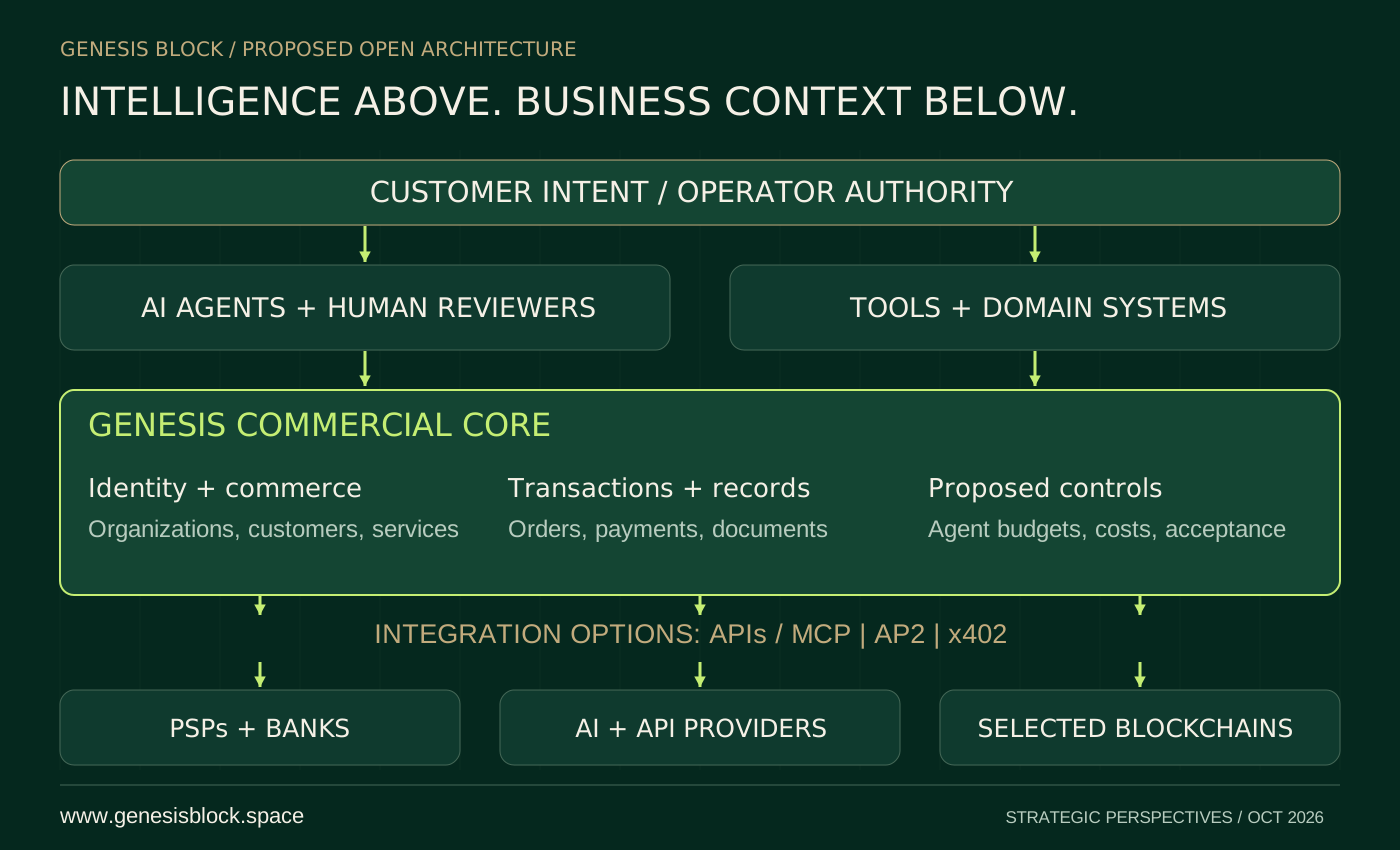
A reusable core gains value when it connects to changing infrastructure. The intended architecture for Genesis is model agnostic and blockchain agnostic: select intelligence, service providers and settlement routes for the workflow, then connect them through defined interfaces.
Each chosen blockchain still needs an adapter, finality handling, permissions and testing. The same discipline applies to models and payment providers. Interchangeability is an engineering property to demonstrate.
Open standards can help. MCP connects AI applications to external tools. Google's Agent Payments Protocol addresses evidence of delegated purchase authority through mandates. x402 defines a payment handshake for paid resources. Each concerns a different part of the transaction. 10,11,12
Genesis's proposed role is to retain the business context: the organization, customer, service, order, approved budget, delivery evidence and commercial record. The operator needs to know what was bought, who accepted it and which obligations remain.
An AI proposal and an authorized action must stay distinct. Reading data, preparing documents, communicating with customers and moving money can require different permissions. Operational balances also remain distinct from bank balances and statutory accounting.
This approach lets a business adopt new intelligence or rails while preserving the commercial history its customers and partners depend on.
One core can become many businesses
An AI agency is a natural initial customer because it already sells work with a brief, a deadline and a review process. Its expertise, audience and delivery method can remain its own. Genesis can supply the commercial backbone connecting its customers, service packages, orders, payments and partner relationships.
Imagine a research studio selling a market brief. The studio defines the deliverable and evidence standard. External agents collect and organize approved sources; an analyst checks the argument; the client receives a versioned report. The proposed order record connects the delivery to every material cost and customer decision.
The repeatability test: does the second business reuse more than the first?
The same core could serve a professional network selling consultations and supporting materials, or a specialized operations provider processing document packages. Each needs different domain expertise and integrations. The common infrastructure remains recognizable: customer, service, order, work, acceptance, payment and documents.
White-label distribution creates another route. An established operator brings its brand, customer access and domain procedures. Genesis supplies the reusable foundation and agreed extensions. Independent systems and centrally managed instances, as described in the documentation, provide an architectural starting point for that deployment model. 13,14
A partner-led operator can also preserve a commercial lineage from referrer to customer, order and earned reward. Genesis's loyalty and supplier-seller foundations make this a natural extension, while exact attribution, reversals and payout rules belong in the selected implementation scope.
This does not mean every industry can be launched through configuration alone. Sector rules, data access, specialist software and human accountability determine the real scope. The opportunity is to reuse the common commercial layer so the next product can concentrate investment on its distinctive requirements.
For a platform buyer, the practical test is the second launch. How much of the customer model, catalog, order lifecycle, payment integration and document logic can be reused? Which extensions become configurable assets? Reuse becomes commercially valuable when it reduces measured deployment effort.
Genesis can be assessed as a business factory on that evidence: a foundation on which partners repeatedly build and operate specialized services.
The business model beneath the business
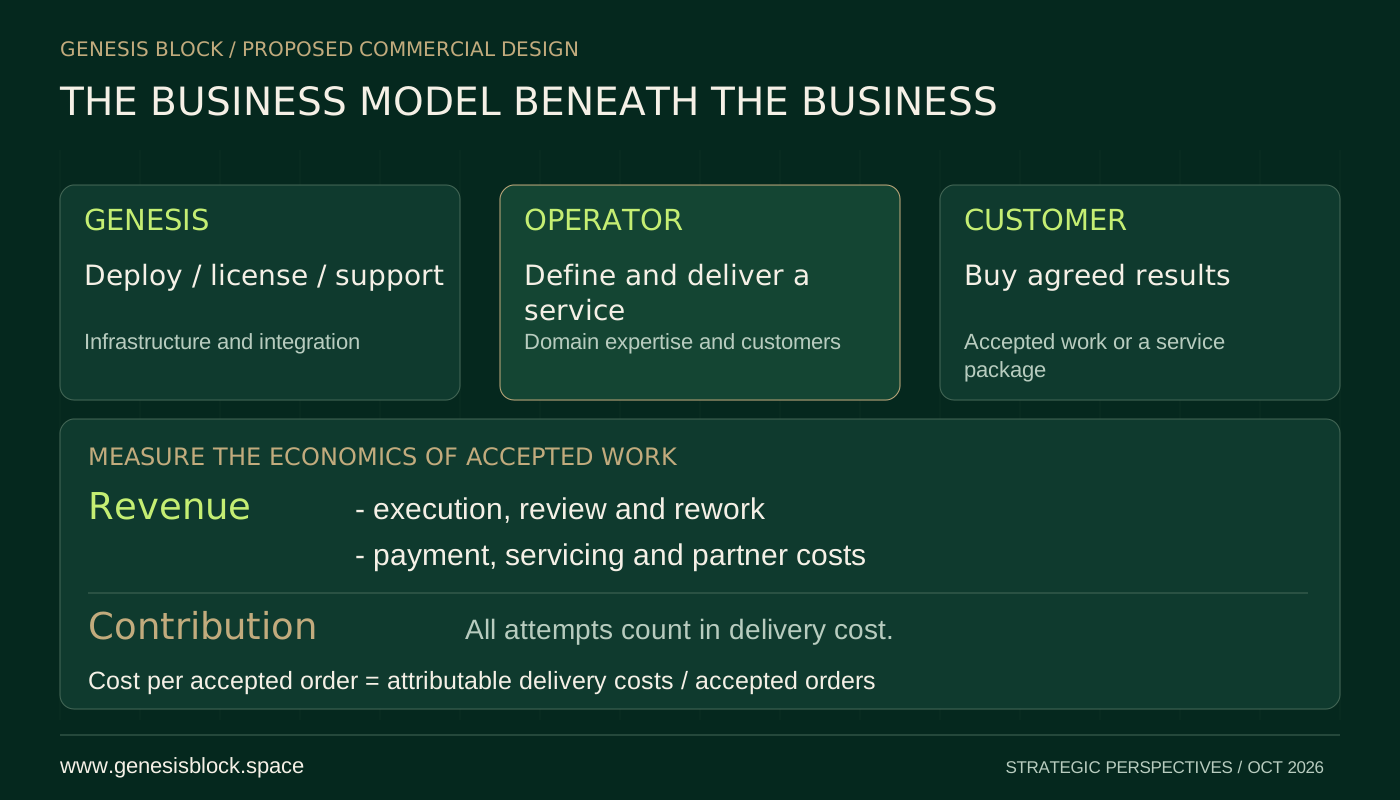
Outcome delivery does not require every participant in the stack to use the same tariff. A Genesis operator may pay for implementation, infrastructure, support and integration capacity. Its customer may purchase an accepted document package, a completed research brief or a recurring service with defined deliverables.
This creates several potential revenue lines for Genesis: deployment and integration fees; recurring operator or dedicated-instance licensing; support; and agreed fees associated with fulfilled services. A share of a partner-operated product can be negotiated separately. These are proposed commercial options, not established revenue claims.
The operator's unit economics must include all attempts. Cost per accepted order equals the total attributable execution, verification, rework and direct servicing costs divided by accepted orders. Payment costs, acquisition costs and partner remuneration must also be included in the relevant contribution and customer economics.
Bundling small internal tasks into a customer-facing result can make buying simpler. It also transfers execution variance to the supplier. A bounded scope, clear acceptance rule and spending limits therefore have economic value.
The best tariff follows the work. Usage pricing suits a resource the customer controls; outcome pricing suits autonomous delivery with clear attribution; hybrid models can fund continuing availability while keeping the delivered unit visible.
The investment case must survive measurement
The strongest case for Genesis is that a shared commercial core can make repeated product launches and service delivery more efficient. The same thesis has an obvious challenge: AI also reduces the cost of writing backend code. A large codebase alone offers limited evidence of durable advantage.
The more defensible assets would be verified integrations, reusable commercial rules, operating history, partner distribution and a growing body of delivery data. Their value depends on whether they reduce implementation work, exception handling and cost per successful order for the next customer.
The investable asset is a repeatable system for delivering paid work.
A client should measure elapsed time from brief to acceptance, editor or operator minutes, revision frequency, fulfillment failures and the completeness of the order record. Those metrics expose whether automation creates value after the review burden is included.
An investor should add deployment effort, recurring operator revenue, contribution after variable costs, retention, expansion and dependence on individual providers. For a partner-led model, partner activation and repeat sales matter more than the size of an unqualified contact list.
Product maturity should remain legible. The Genesis documents support a foundation of commerce objects, APIs, documents and integrations. Historical processing capabilities belong in a separately verified migration scope. Agent permissions, task queues, cost metering and outcome acceptance are proposed extensions to implement and test.
A credible demonstration should include exceptions. Show a duplicated payment event, a failed provider call, an exhausted task budget, a rejected result and a correction to a commission. The ability to recover while preserving the commercial record is part of the product.
The next commercial milestone is a paid workflow with measured delivery economics. A successful deployment should create reusable configuration and integrations, so the following customer benefits from work already completed. That is where a service implementation can begin to compound into a platform business.
That is a clear diligence agenda for a buyer or investor: identify the reusable foundation, demonstrate the selected implementation and establish whether the business improves as more work flows through it.
Start with one complete transaction
Musk's Macrohard ambition is a useful signal of how far software may move toward performing work. It also directs attention to the infrastructure required when AI becomes an operating participant in a company. Intelligence needs a defined relationship with customers, obligations, authority and money.
For Genesis, the immediate opportunity is a bounded deployment: one operator, one service package, explicit acceptance criteria, a connected payment route and a complete record from order to delivery. Human reviewers remain where the selected product needs them.
The pilot should establish the current API and module scope, implement the missing agentic controls and run representative paid orders, including failure and correction cases. Expansion should follow evidence of acceptable quality, manageable human involvement and sound delivery economics.
Prospective clients bring a recurring workflow and a clear customer need. Delivery partners bring domain knowledge and distribution. Genesis brings its documented commercial foundation and the implementation scope required to connect it to the selected execution stack.
The next wave of AI businesses will be judged by what customers can reliably buy and receive. Genesis Block's proposition is to provide the foundation on which that commerce can be built.
One core. Many businesses. Measurable results.
Sources and evidence
- Elon Musk: original Macrohard announcement. X. Primary statement of the AI software-company ambition.
- Elon Musk: Macrohard / Digital Optimus. X. Primary description of the joint project and division of direction and action.
- Claude Cowork. Anthropic. Delegated task execution across files and tools.
- Introducing Effort-Based Pricing for Replit Agent. Replit. Time and computation as a pricing basis.
- Plans and Pricing. n8n. Workflow-execution metering.
- Fin AI Agent outcomes. Intercom. Outcome prices, resolution definitions and reversal rules. Published 23 September 2026.
- Outcomemaxxing. Sierra. Outcome attribution, autonomy and pricing economics. Published 3 June 2026.
- Agentforce Pricing. Salesforce. Action, conversation and user-based purchasing options.
- Copilot Studio Licensing Guidance. Microsoft. Credit-based purchasing and pay-as-you-go metering.
- What is the Model Context Protocol?. MCP documentation. External-tool interface standard.
- Powering AI commerce with AP2. Google Cloud. Delegated purchase authority and mandates.
- How x402 works. Coinbase Developer Documentation. Payment handshake and supported integration concepts.
- Brief description of the PayHub system. Genesis internal technical documentation. Supplied primary documentation covering commerce objects, HTTPS API, roles, loyalty, documents and instances.
- PayHub module documentation. Genesis internal technical documentation. Orders; documents; organizations; systems and clusters; external services; price lists, locations, suppliers and sellers. Supplied primary records reviewed.
- General description of processing. Genesis historical technical documentation. Provider switching, agent networks, limits and remuneration. Historical capabilities require selected-version verification.
- How do you like THAT, Elon Musk?. Vicki Boykis / Normcore Tech. Background to the editorial title; published 3 October 2019.
Prepared for prospective clients and investors. Public sources checked 26 October 2026. Product mapping uses supplied Genesis documentation, not a repository audit or live deployment certification. Figures identify documented foundations, historical capabilities and proposed extensions. Provider names describe market examples or possible interfaces; no affiliation or completed integration is implied. The conceptual cover is an AI-generated editorial illustration.